
Introducing Narrative Demand™
An emerging concept from the Narrative Power for Justice Initiative exploring the gap between dominant narratives and the stories that remain underrepresented, distorted, or absent in culture and media.
Narratives shape more than representation. They influence whose experiences are believed, whose humanity is recognized, what receives public support, and what society views as deserving of care, protection, and investment.
In partnership with PerryUndem, In Our Own Voice conducted qualitative research with Black women, girls, and gender-expansive people across the country to better understand how Black women experience today’s cultural narratives — and what stories feel missing, distorted, or urgently needed.
This research introduces an emerging concept from Narrative Power for Justice:
What is Narrative Demand™
Narrative Demand™ is the gap between dominant narratives and the stories Black women actually want and need to see in order for their realities, dignity, and treatment to be fully understood — and for justice-centered policies to become possible and supported.
Narrative Demand moves beyond identifying harmful stereotypes. It asks a different question:
What stories feel missing?
Narrative Demand™ is an emerging concept developed through In Our Own Voice’s Narrative Power for Justice Initiative (NPJI).
Our research found that Black women are not only rejecting harmful portrayals. They are actively naming a demand for stories rooted in care, emotional safety, dignity, joy, support, healing, stability, tenderness, and full humanity (see Research Snapshot 1).
Narrative Signals Emerging From the Research

Black women are asking for more complete stories
Participants repeatedly described wanting stories that move beyond crisis, survival, and stereotype toward portrayals rooted in care, dignity, emotional honesty, softness, joy, stability, and everyday life.
Audiences are responding to stories grounded in support and connection
Participants expressed strong interest in stories centered on:
- sisterhood and uplifting one another
- healthy relationships
- emotional safety
- healing
- rest
- support
- Black women receiving care instead of only providing it
People want stories that show what support actually looks like
Participants described wanting portrayals where Black women are:
- listened to
- protected
- respected
- emotionally supported
- treated with dignity
- able to thrive
Representation is about more than visibility
Participants consistently connected storytelling to broader questions of recognition, treatment, legitimacy, and opportunity.
Narratives shape not only what audiences see — but what they believe should exist, what deserves support and investment, and whose lives are treated as valuable.
“These stories feel like a collective exhale. They aren’t about proving humanity; they are about enjoying it.
Freedom means the plot isn’t driven by suffering. The atmosphere is one of safety. Seeing Black women being deeply cared for by themselves and their community.
There is no one way to be.
These stories don’t have to explain; they simply exist.”
— Research participant, 50, Georgia
What Audiences Are Responding To
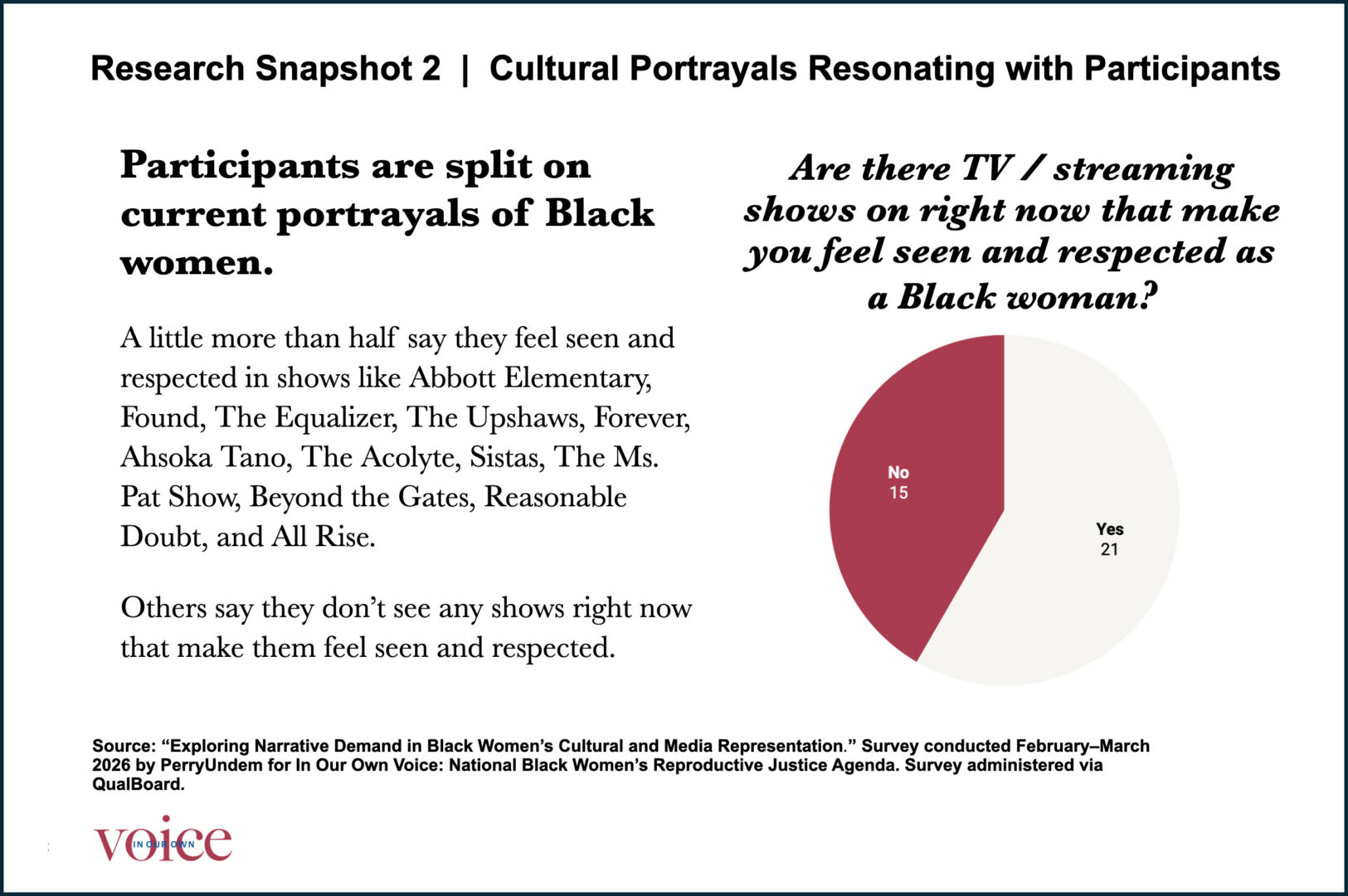
Participants frequently referenced shows that made them feel more seen, respected, or emotionally connected, including:
- Abbott Elementary
- Forever
- Insecure
- Sistas
- The Equalizer
- Bel-Air
- All American
More than half of participants were able to identify at least one current television or streaming portrayal that felt more expansive, emotionally honest, or reflective of Black women’s lives and experiences (see Research Snapshot 2).
Participants often described responding to portrayals that reflected:
- emotional openness
- multidimensionality
- everyday life
- ambition and vulnerability
- supportive relationships
- healing
- joy
- Black women receiving care and support
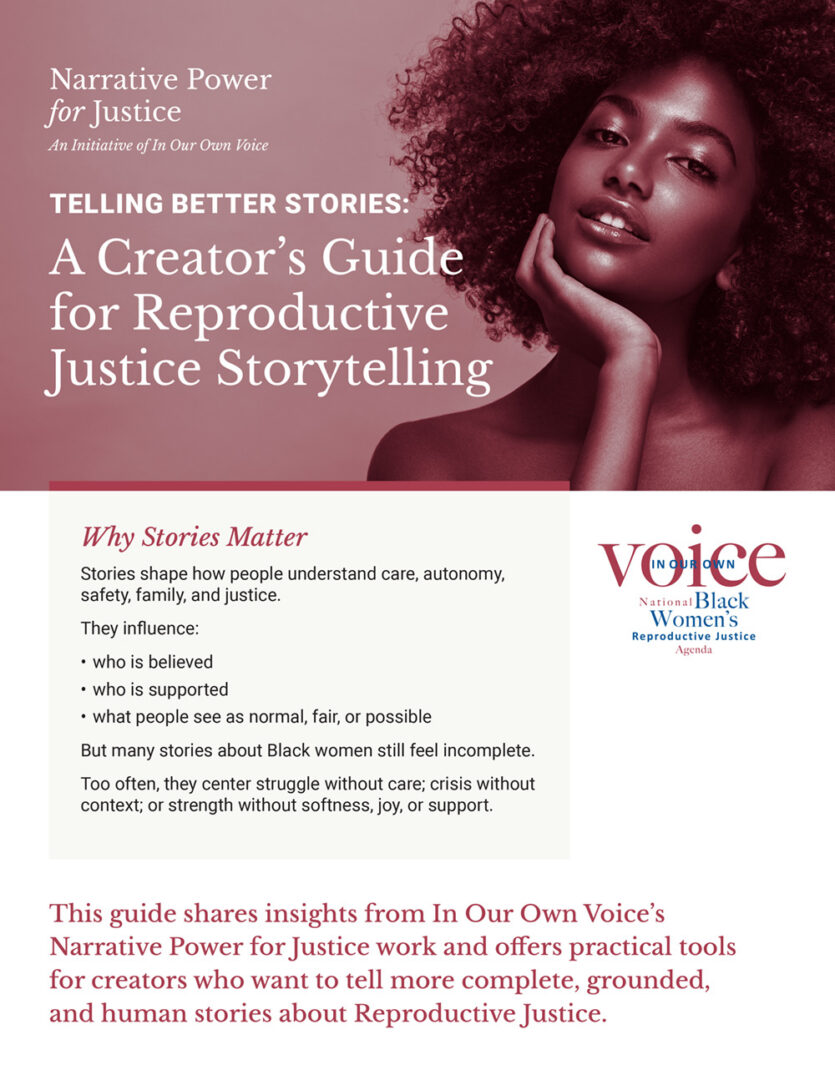
Telling Better Stories: A Creator’s Guide for Reproductive Justice Storytelling
A practical resource for creators, writers, strategists, producers, and cultural leaders seeking tools for more complete storytelling rooted in care, complexity, structural truth, and lived reality.
About Narrative Power for Justice
Narrative Power for Justice (NPJI) is an initiative of In Our Own Voice focused on building narrative infrastructure that shapes how Black women and Reproductive Justice are understood across culture, media, and policy.
NPJI integrates:
- qualitative and quantitative research
- creator partnerships
- movement strategy
- narrative analysis
- cultural intervention
Methodology Note
In Our Own Voice: National Black Women’s Reproductive Justice Agenda commissioned PerryUndem to conduct qualitative research with Black women and girls across the United States exploring cultural representation, storytelling, and Narrative Demand™.
The research, Exploring Narrative Demand in Black Women’s Cultural and Media Representation, included five days of in-depth asynchronous interviews conducted over a two-week period in February and March 2026 using QualBoard, an online qualitative research platform. Participants logged in daily at their convenience to respond to open-ended prompts, reflections, and creative exercises. Across the study, participants answered more than 60 questions and generated 2,333 responses.
The research approach was intentionally community- and participant-centered. Rather than simply reacting to existing media portrayals, participants were invited to actively identify narrative gaps, emotional realities, and the kinds of stories they long to see reflected in culture.
As part of the process, participants conducted their own mini-ethnography by observing how Black women appeared across their daily media consumption and documenting those reflections in an online journal. Participants contributed 146 observational entries.
On the final day of the research, participants completed a narrative world-building exercise in which they created character sketches for hypothetical television shows centered on Black women and girls. Through these exercises, participants contributed not only opinions, but also language, emotional insight, imagery, and narrative vision.
Phase two of the project will include a nationally representative survey of 1,000 Black women ages 18 and older, scheduled for Summer 2026.