
How Lived Experience Determines Narrative Authority
This issue brief interprets our national and state polling through a narrative power lens—connecting lived experience to culture, policy, and movement strategy.
Black women’s lived experiences offer critical insight into how autonomy, power, and possibility are understood in the United States. National and state polling conducted by In Our Own Voice: National Black Women’s Reproductive Justice Agenda shows that Black adults consistently understand autonomy not as an individual choice, but as something shaped by lived structural reality—healthcare access, economic stability, safety, and freedom from discrimination.
This issue brief draws on findings from The Lives & Voices of Black Families (2024), Views Toward Voting in 2022 among Black Women (2022), and The Lives and Voices of Black Adults Across 10 States (2025) surveys to illuminate the social and structural context Black communities bring when they encounter stories in media, culture, and public conversations.
Together, these findings help explain why certain portrayals of Black women resonate as authentic and affirming—while others feel distorted, incomplete, or harmful.
Rather than treating representation as symbolic, this brief situates narrative authority in lived reality: the everyday systems and conditions that shape how autonomy, trust, dignity, and fairness are experienced.
Narrative authority does not live in any single story or storyteller. It is produced through the systems and relationships that determine whose lived experience is recognized as credible, repeatable, and worthy of shaping public understanding. Narrative power is foundational to cultural meaning, representation, and policy outcomes.
Systemic Barriers Shape Everyday Life
Across multiple surveys, Black adults describe a shared structural reality that shapes their families’ well-being, autonomy, and sense of possibility. Economic insecurity, healthcare access, and systemic inequities consistently emerge as the most pressing concerns, shaping how respondents experience freedom, opportunity, and justice in their daily lives.
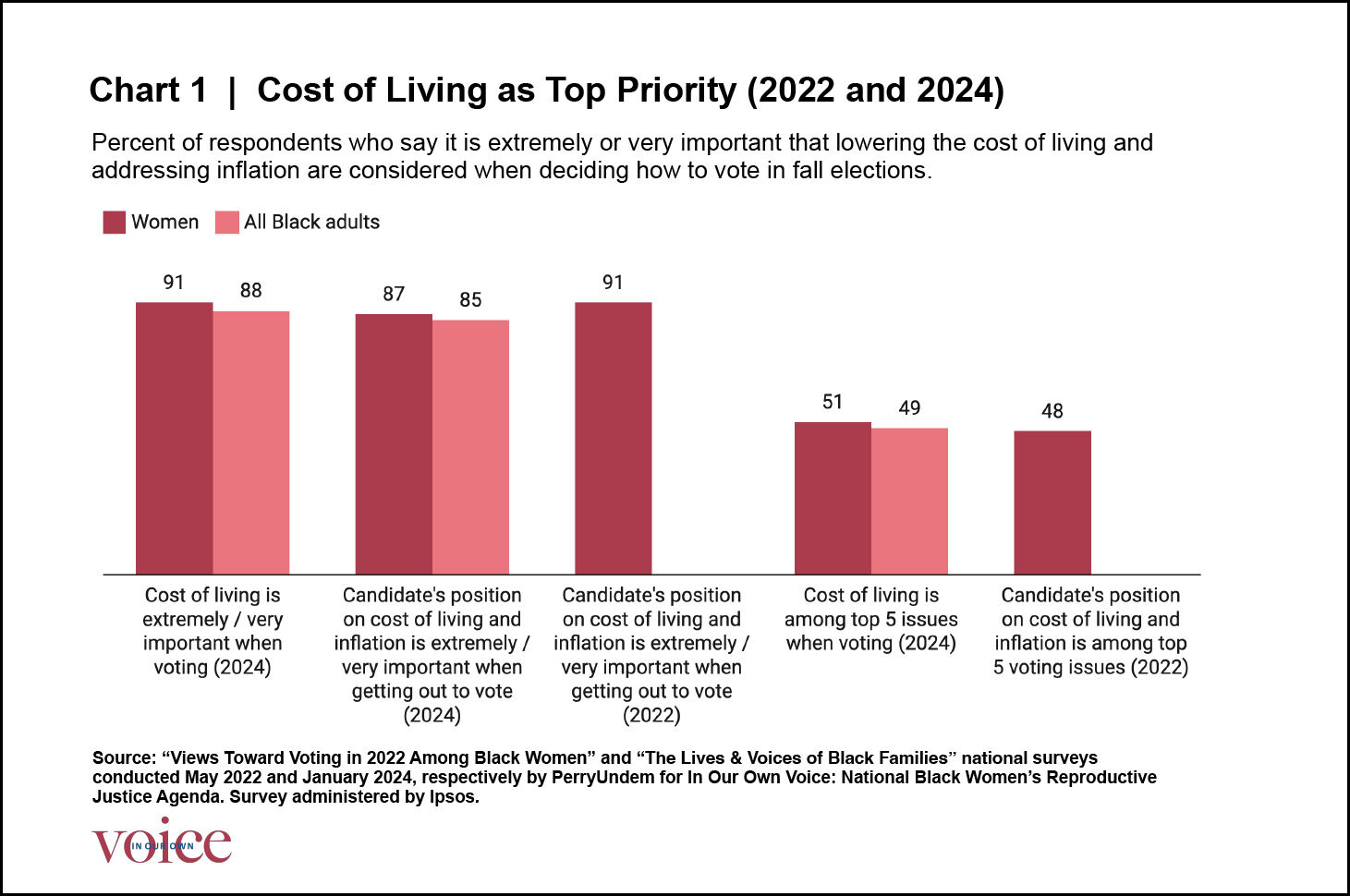
A large majority of Black respondents consider policies that reduce the cost of living and control inflation extremely or very important for their vote in national elections, highlighting that economic issues are central to everyday security and long-term opportunity.
Recent state polling shows that economic security and healthcare access remain top concerns for Black families, with Black women of reproductive age reporting some of the greatest structural barriers (IOOV, 2025):
- More than 90% of respondents say Medicaid has been important to them or their families, underscoring the central role of safety-net programs in sustaining health, stability, and care.
- More than 85% believe that dismantling systemic racism is necessary for Black families to thrive, reflecting a broad understanding that autonomy is shaped by systems, not solely by individual effort or choice.
For Black women ages 18–44 across ten states, structural risk directly shapes deeply personal decisions:
- A majority report that their risk of death in pregnancy (54%) is a factor in decisions about having children.
- Nearly half (44%) say the possibility of criminalization influences those decisions.
These findings reveal how structural forces such as healthcare access, legal risk, and systemic bias are embedded in intimate questions of family, safety, and future planning.
Together, these data points reflect a shared understanding that autonomy is both constrained and enabled by structural realities. These realities shape how people understand stories about choice, care, and justice. When narratives focus only on individual decisions and ignore the systems that shape risk and opportunity, they fail to reflect lived experience and often land as incomplete, unrealistic, or out of touch.
Bias and Trust in Institutions
Experiences of bias, particularly in healthcare and public institutions, shape trust, care, and credibility. Across surveys, respondents consistently describe racism and gender bias not as isolated incidents, but as ongoing structural forces that influence their expectations of systems designed to protect and serve them.
Recent polling underscores the pervasiveness of these experiences. In the 2025 state survey, 31% of all respondents felt a healthcare provider did not take their concerns seriously because of their race. In the 2024 national survey, a similar share of Black women reported being treated differently for the same reasons. Nearly one-third (31%) said a healthcare provider failed to take their concerns seriously due to their race and/or gender. These patterns are echoed across respondents, reinforcing that experiences of dismissal and differential treatment are widespread rather than isolated.
Over time, repeated encounters with bias erode confidence that institutions are designed to deliver fair, dignified, or equitable care. This erosion of trust does not remain confined to individual interactions. It shapes broader expectations about whose knowledge is believed, whose pain is taken seriously, and whose lives are treated as worthy of protection. In this context, skepticism toward institutions reflects not disengagement, but lived evidence.
This institutional context helps explain why representation in media, culture, and public discourse carries such weight. When systems are experienced as neglectful or punitive, stories that affirm Black women’s humanity, autonomy, and leadership become essential to rebuilding trust, reshaping public understanding, and influencing public support for justice-aligned policies.
This context explains why narratives that ignore structural realities often feel implausible or extractive to Black audiences.
Connecting Data to Narrative Power
Taken together, these findings show that stories don’t exist apart from real life. They are shaped by the same systems that shape people’s choices, trust, and access.
Narrative power is a community’s ability to tell its own stories, challenge dominant assumptions, and shape culture, media, and policy. It isn’t just about being seen or telling more stories. It’s about capacity. Who has the microphone and who gets to define what’s true and believable. And which stories are repeated often enough to shape how the public understands the world.
That kind of power doesn’t come from a single story or moment. It builds over time, as narratives are reinforced across relationships, institutions, and cultural spaces. It grows through leadership, creative expression, and deep community connection and it is rooted in lived experience, not stereotypes, abstractions, or crisis framing.
Because Black women move through healthcare, economic, and legal systems that have long limited autonomy and eroded trust, they listen to stories with a sharp awareness of context. Stories that name risk, constraint, and inequality feel honest.
Stories that frame “choice” without acknowledging these realities often feel incomplete or off.
In this way, narrative power functions as a form of structural influence. It shapes the boundaries of what feels possible, reasonable, or just long before policy debates occur. Understanding narrative power through lived experience clarifies why representation alone is insufficient and why sustained influence over cultural meaning is essential to advancing justice.
Narrative Power as Justice Infrastructure
In Our Own Voice understands narrative power not as messaging or media visibility alone, but as a form of justice infrastructure—an essential system that shapes whose experiences are recognized as credible, whose knowledge is treated as authoritative, and whose lives are imagined as worthy of care, protection, and possibility.
Today, powerful institutions, including media, policy discourse, research agendas, philanthropy, and other gatekeeping systems, largely control this infrastructure, shaping which narratives become widely accepted. These narratives don’t just influence how people feel. They help determine which issues rise to the level of public concern and which policy priorities are seen as reasonable or necessary.
The data shows why narrative authority matters. Infrastructure explains how that authority is built, protected, and sustained. Structural realities—economic insecurity, healthcare inequities, and institutional bias—shape not only lived experience, but the cultural conditions under which stories are believed, dismissed, or distorted. Narrative infrastructure is what determines whether those realities are reflected accurately in public understanding over time, and whether that understanding has durability beyond any single moment or story.
As articulated by the authors of What Is Narrative and Solidarity Infrastructure—and Why Are We Building It?, narrative infrastructure refers to the interconnected systems, services, relationships, and platforms that enable stories, perceptions, and understandings to be constructed, shared, and evolved (BLIS Collective, 2025). It is not activated in isolated moments of media attention or political debate, but built through sustained investment across sectors—media, culture, research, policy, philanthropy, and organizing.
Because cultural narratives establish the terrain on which policy debates take place, narrative power is a prerequisite—not an add-onto policy change. Without narrative infrastructure, even well-designed policies remain fragile, easily reversed, or unevenly implemented.
Narrative infrastructure is strongest when paired with solidarity infrastructure—the relationships and alignments that allow stories to move across movements, institutions, and communities on a deeper level. This kind of infrastructure equips “a tight network of people organizing on the ground and working within various sectors to develop strategic and powerful narrative ideas,” enabling change at the level of a society’s operating system rather than through isolated interventions.
Without solidarity, narrative infrastructure risks visibility without protection. When braided together, narrative and solidarity infrastructure ensure that stories not only circulate, but endure—reinforced by shared values, collective action, and mutual accountability.
Implications of Narrative Power as Justice Infrastructure
This is why In Our Own Voice invests in narrative power as justice infrastructure: to ensure Black women are not only represented in stories but recognized as authorities over their own lives—and as architects of the cultural conditions that shape policy, care, and freedom.
Seen this way, narrative power becomes a strategic investment rather than a communications tactic. When narrative infrastructure is weak or fragmented, harmful narratives persist—even in the presence of strong data or policy proposals. When it is robust, narratives rooted in lived experience shape the public imagination, influence institutional behavior, and create durability for justice-aligned change.
Relationships across movements, sectors, and communities allow stories to travel without distortion and provide protection against backlash, translating narrative power into durable action. Together, narrative and solidarity infrastructure create the conditions for lasting cultural change—ensuring that stories do not simply surface, but endure.
Implications for Movement Strategy
Narrative power is a core strategic asset, not an add-on. Narratives aligned with structural realities of autonomy and fairness mobilize support, sustain engagement, and withstand opposition.
Investing in narrative power strengthens movement strategy by shaping agenda-setting, coalition alignment, and defense against backlash. When narratives are rooted in lived experience and reinforced across organizing, research, and cultural production, they establish shared frames that make collective demands feel reasonable, necessary, and urgent.
Without narrative infrastructure, movements risk fighting policy battles on hostile cultural terrain. With it, movements are better positioned to influence public understanding over time—shaping not only what policies are proposed, but which futures are imaginable and defensible. Narrative power, in this sense, expands the conditions under which organizing can succeed.
Implications for Policy and Philanthropy
A 2022 RWJF assessment of narrative change, identified mass movements as a critical component of the narrative change field, highlighting the importance of localized narrative hubs that reach people where they actually are (Sen & Moore, 2022). Bridgit Antoinette Evans (2022), CEO of the Pop Culture Collaborative, urges the field to move beyond shifting narratives on individual issues and instead “embrace the hard work of transforming whole narrative oceans.”
Only community-powered movements can transform narrative landscapes, requiring both financial investment and sustained support for people and relationships that move culture over time. Partner with us to build narrative power as justice infrastructure.
Implications for Storytellers
Stories don’t exist apart from the realities Black communities live. They are received through our challenges, resilience, and collective experience. For writers, producers, and creatives shaping stories about Black women, this data underscores a core truth: audiences are deeply attuned to structural realism, not just emotional beats. Stories that isolate “choice” from the systems that shape risk, care, and constraint often feel false. Authentic representation begins well before a script is finalized. It requires understanding how Black women actually experience power, dignity, and limitation—and how stories are reinforced or undermined by the broader narrative ecosystem they enter.
When storytellers treat lived experience as narrative authority, stories gain deeper resonance, cultural credibility, and protection against harmful tropes or crisis-driven framing. Narrative power is not only about whose stories are told, but who gets to shape them. Building narrative power, then, is not about visibility alone, it is about creating the shared conditions under which justice can be imagined, defended, and sustained.
Black women do not encounter stories as abstract narratives—they encounter them through lived systems that shape trust, risk, and credibility long before the story begins.
References
- Black Liberation–Indigenous Sovereignty (BLIS) Collective. (2025). What is narrative and solidarity infrastructure—and why are we building it?
- Evans, B. A. (2022). To change the world, transform narrative oceans. Pop Culture Collaborative.
In Our Own Voice: National Black Women’s Reproductive Justice Agenda. (2025). The Lives & Voices of Black Adults Across 10 States [State Survey]. - In Our Own Voice: National Black Women’s Reproductive Justice Agenda. (2024). The Lives & Voices of Black Families in 2024 [National survey].
- In Our Own Voice: National Black Women’s Reproductive Justice Agenda. (2022). Views Toward the Voting in 2022 among Black Women [State Survey].
- Sen, R., & Moore, M. (2022). Funding narrative change: An assessment and framework. Convergence Partnership.
Methodology Note
This brief draws on findings from three major research efforts conducted by In Our Own Voice. Surveys were conducted among Black adults across multiple states using mixed-mode methodologies (online and phone). Samples were weighted to reflect the demographics of Black adults by age, gender, education, and geography.
In Our Own Voice: National Black Women’s Reproductive Justice Agenda commissioned the research firm PerryUndem to conduct state polling examining the lives, values, and perspectives of Black adults across the United States. The Lives and Voices of Black Adults Across 10 States was administered online by Ipsos and fielded between May and July 2025. The study reached a total sample of 5,262 Black adults aged 18 and older across 10 states: Georgia, New Jersey, Pennsylvania, Ohio, Michigan, Virginia, North Carolina, Florida, Nevada, and California. State-level samples were designed to allow for robust within-state analysis. The sample size was 3,739 for the question on the importance of Medicaid, 3,100 for the question on dismantling systemic racism, 5,262 on the question of taking health care concerns seriously, and 1,351 for the questions of death during pregnancy and the possibility of criminalization. The margin of sampling error ranges from ±4.5 to ±6.5 percentage points, varying by state.
The Lives & Voices of Black Families National Survey (2024) captures Black adults’ experiences, values, and perspectives on healthcare access, economic security, safety, and systemic bias. The survey included 1,005 Black adults nationwide and was fielded from January 22–27, 2024, via Ipsos’ KnowledgePanel, an online panel constructed from address-based probability sampling. Data were weighted to reflect a representative sample of Black adults nationally. The sample size was 1,005 for the questions on taking health care concerns seriously and cost of living. The margin of sampling error is ±3.5 percentage points. The survey also includes oversamples in nine states: California, Georgia, Louisiana, Michigan, Ohio, Pennsylvania, Tennessee, Texas, and Virginia.
Views Toward Voting in 2022 Among Black Women was commissioned by In Our Own Voice: National Black Women’s Reproductive Justice Agenda and conducted by PerryUndem. The survey reached 1,016 Black women registered voters from May 5–20, 2022, using Ipsos’ KnowledgePanel. The sample size was 1,016 for the question on cost of living. The margin of sampling error is ±3.8 percentage points. This research explored voting participation in the 2022 midterms, issue priorities, and reactions to current events.
While these surveys were not designed as media or audience research, they capture lived experience, values, and perceptions of autonomy, bias, and structural conditions that shape how narratives are received and interpreted. This brief examines existing data to illuminate the cultural conditions that influence representation, meaning-making, and public imagination.