What Black Communities Say About Representation in Culture and Media
Stories shape what we believe is normal, who we see as deserving of care, and how we understand power. For Black communities, representation in media is not just about visibility. It is about dignity, fairness, and justice.
In October 2025, In Our Own Voice released a multi-state survey, The Lives and Voices of Black Adults Across 10 States, exploring how Black adults experience and understand a range of social, cultural, and policy issues. Among its findings was a clear and consistent message: representation of Black women in culture and media matters deeply and it has real-world consequences.
This brief highlights findings from the survey focused specifically on representation, offering insight into why Black audiences see visibility as both personal and political, and why narrative power is central to advancing Reproductive Justice.
Representation Is Not Symbolic — It’s Foundational
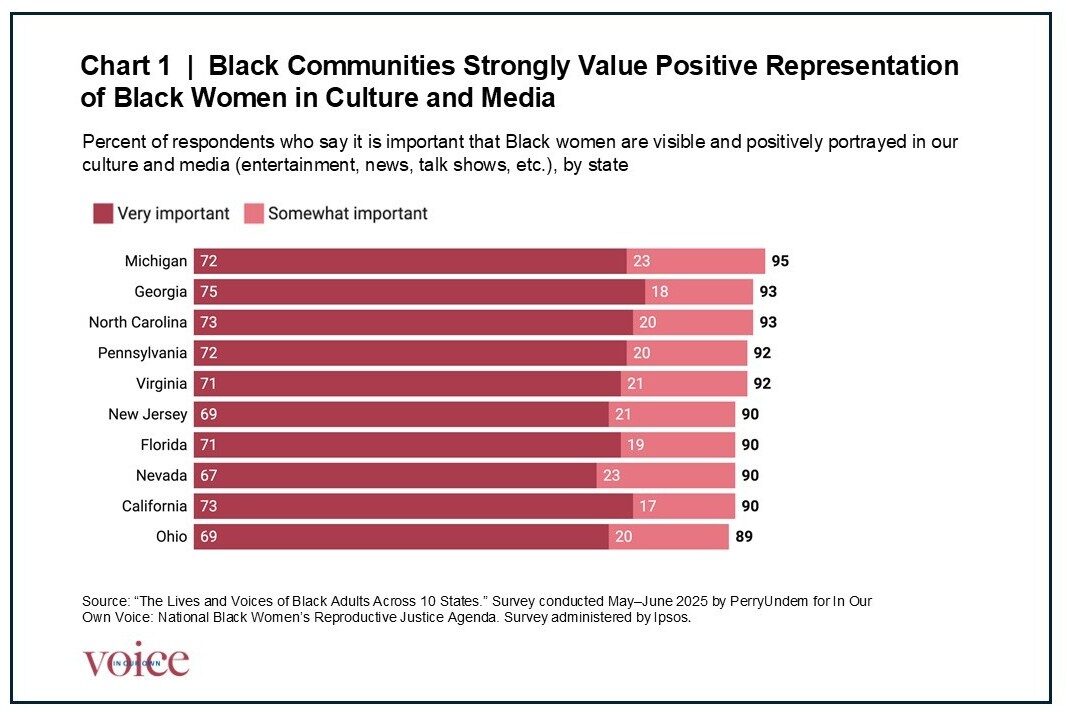
Across all ten states surveyed, a large majorities of Black adults 18+ said it is important that Black women are visible and positively portrayed in culture and media, including entertainment, news, and talk shows.
Ninety-one percent (91%) of all survey respondents said that positive and visible representation of Black women is important, with 71% saying it is “very important.” This finding held largely consistent across states, regardless of geography.
This level of agreement signals something critical: for Black communities, representation is not an abstract cultural concern. It is widely understood as something that shapes attitudes, expectations, and treatment in everyday life.
Why Representation Matters: Lived Experience and Justice
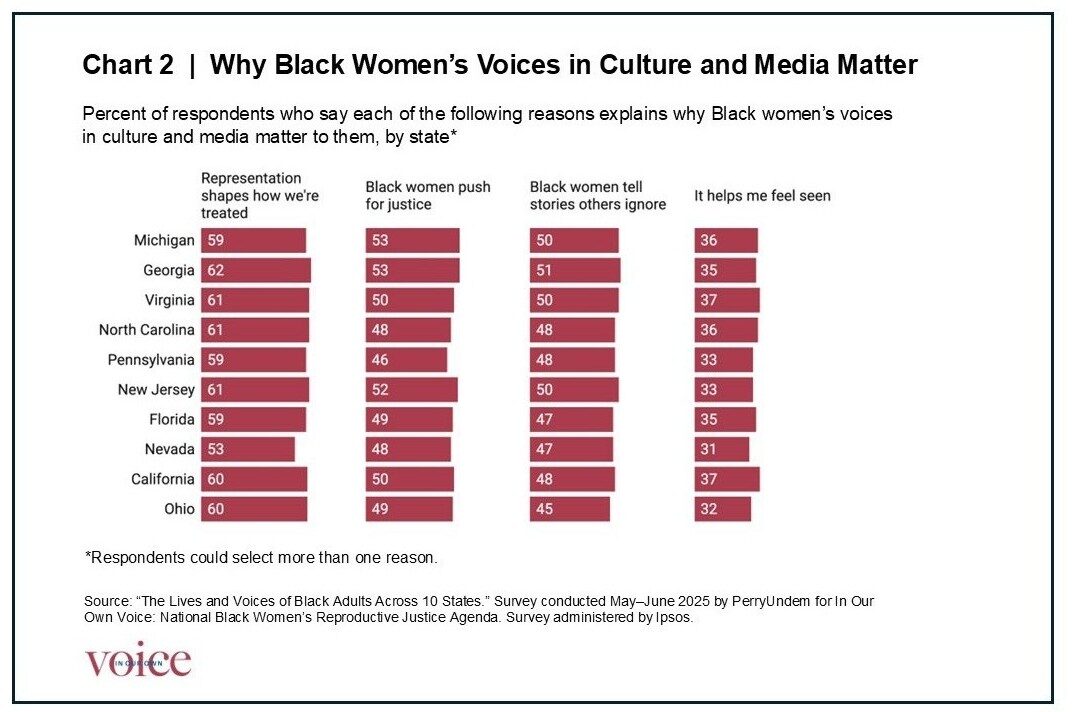
To better understand why representation matters, the survey included a follow-up question asking respondents what makes Black women’s voices in culture and media important to them. Participants could select multiple responses.
The most common answer—chosen by more than 60% of respondents—was that representation shapes how Black people are treated.
Other top reasons reinforce the idea that Black women’s stories do critical work that is often left undone:
- Black women tell stories others ignore
- Black women push for justice
- Seeing Black women represented helps people feel seen
Taken together, these responses point to a shared understanding:
Black Women’s Stories Fill the Gaps Others Leave Behind
They illuminate experiences that are routinely erased, oversimplified, or misrepresented—and they challenge narratives that limit how Black women are understood in public life.
Representation Is a Pathway to Justice
These findings underscore a critical truth: representation is not neutral.
For Black audiences, media portrayals influence how institutions respond, how policies are designed, and how communities are treated. Representation affects everything from whose pain is believed, to whose families are valued, to whose reproductive lives are respected.
This is why representation is a pathway to justice—particularly for Black women, whose bodies, choices, and families have long been subject to harmful narratives rooted in racism and sexism.
When media tells fuller, more accurate stories about Black women’s lives, it creates space for empathy, accountability, and policy change. When it does not, it reinforces stigma, neglect, and harm.
This Isn’t a “Women’s Issue” — It’s a Community Value
Importantly, the survey found very little difference by gender in how respondents viewed representation.
While Black women were slightly more likely to say positive portrayal was “very important,” Black men overwhelmingly agreed that representation matters. This shared perspective highlights that narrative power is not siloed—it is a community value tied to collective dignity and shared futures.
In other words:
This isn’t a “women’s issue.” It’s about how Black communities are seen, treated, and understood as a whole.
From Data to Narrative Power
These findings help explain why In Our Own Voice launched the Narrative Power for Justice Initiative.
Policy advocacy and movement-building remain essential, but they are not enough if harmful narratives go unchallenged upstream. Research like this shows that Black communities already understand what many systems ignore: stories shape power.
Through Narrative Power for Justice, In Our Own Voice is working to:
- Elevate Black women’s lived experiences as narrative authority
- Translate research into insights for media, culture, and storytelling spaces
- Convene storytellers, cultural leaders, and movement partners
- Intervene early in how reproductive health, autonomy, and care are portrayed
Because when narratives change, what’s possible changes too.
Future publications from In Our Own Voice and the Narrative Power for Justice Initiative will explore what Black women want to see more of in media and culture, including preferred story types, themes, tones, and portrayals of Black women and families—disaggregated by age, geography, and other key factors.
Upcoming briefings and convenings will offer deeper insight into how storytelling can more accurately reflect Black women’s lived experiences and help shape cultural narratives that influence public attitudes, policy decisions, and everyday life.
For more findings from The Lives and Voices of Black Adults Across 10 States, visit our State Polling & Resources hub. Download the data here (XLSX file).
Methodology Note
In Our Own Voice: National Black Women’s Reproductive Justice Agenda commissioned the research firm PerryUndem to conduct a multi-state survey examining the lives, values, and perspectives of Black adults across the United States. The survey was administered online by Ipsos and fielded between May and June 2025.
The study reached a total sample of 5,262 Black adults aged 18 and older across 10 states: Georgia, New Jersey, Pennsylvania, Ohio, Michigan, Virginia, North Carolina, Florida, Nevada, and California. State-level samples were designed to allow for robust within-state analysis.
The effective sample size for the overall survey was 2,633 for the question on the importance of representation and 2,608 respondents for the question on why Black women’s voices in culture and media matter. The margin of sampling error ranges from ±5.7 to ±6.6 percentage points, varying by state.
This presents findings from a subset of the survey focused on representation, visibility, and narrative power in culture and media. Additional analyses and publications drawing from this survey will be released throughout 2026.